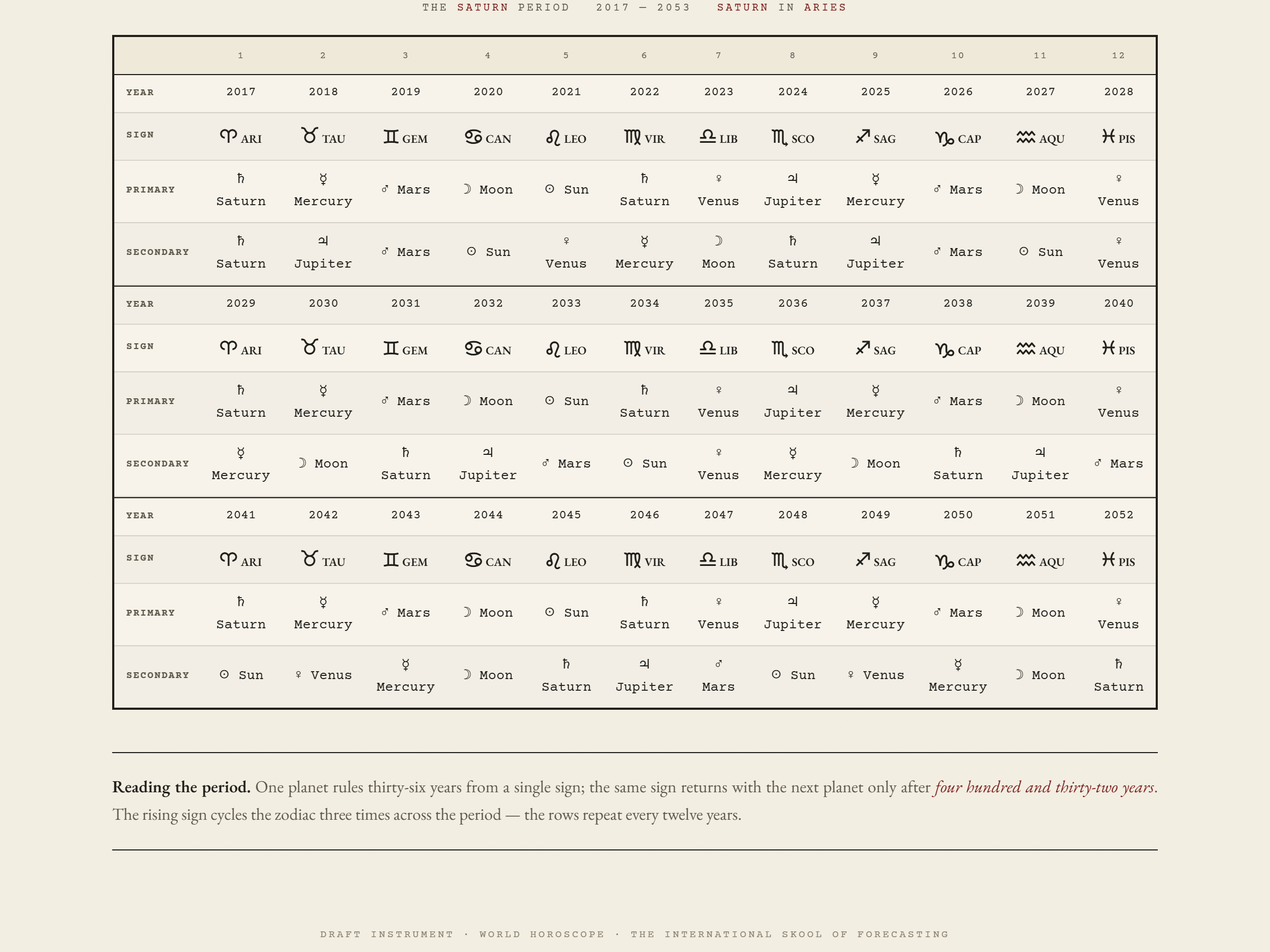
Sepharial's last work, published in 1929 and later reissued as The World Horoscope, sets out a 36-year world cycle, its 2,520-year arithmetic, and a set of coded tables. The source is complete enough to study — but not arranged as a working reading procedure.
The course supplies the missing order: era, year, nation, and the second clock, checked against prior comparable phases. Without that order, the tables are a wall. With it, a research procedure.
Working out that order is most of what this course is. Six parts, twenty-five lessons, and a graded exam closing every part.
Not ready to enrol? Read the full case →
One payment · Lifetime access · Identity check and NDA required before access is released · No change-of-mind refunds once access is released, which does not limit your rights under the Australian Consumer Law
Read this before you read the three cards. None of them is a call the Skool published at the time. All three were assembled after the events, in class, in the same derivation order a live reading follows — chart first, record second, never the reverse. I would rather put that here than let you find it in a footnote. What they demonstrate is the procedure, not foresight. And they are not uniformly flattering: the course keeps the readings that came out loose alongside the ones that came out tight, because a worked example that always succeeds is a sales demonstration rather than a lesson.
And one more thing, before you read anything that flatters me. With the Great War still running, Sepharial published a book called Why the War Will End in 1917. The war ended on 11 November 1918. Earlier he had predicted that Annie Besant would die in 1907; she lived until 1933. The Theosophical Society's own encyclopaedia still records Alan Leo's remark to her afterwards — that by failing to die on schedule she had knocked the bottom out of English astrology. That is the man whose framework I teach.
I teach him anyway, for one narrow reason. He did not leave predictions. He left a structure — a base unit, the arithmetic that ties it together, and the tables. A prediction you can only swallow or reject. A structure you can build, run against a closed year, and break. Read the three cards with that in your hand.
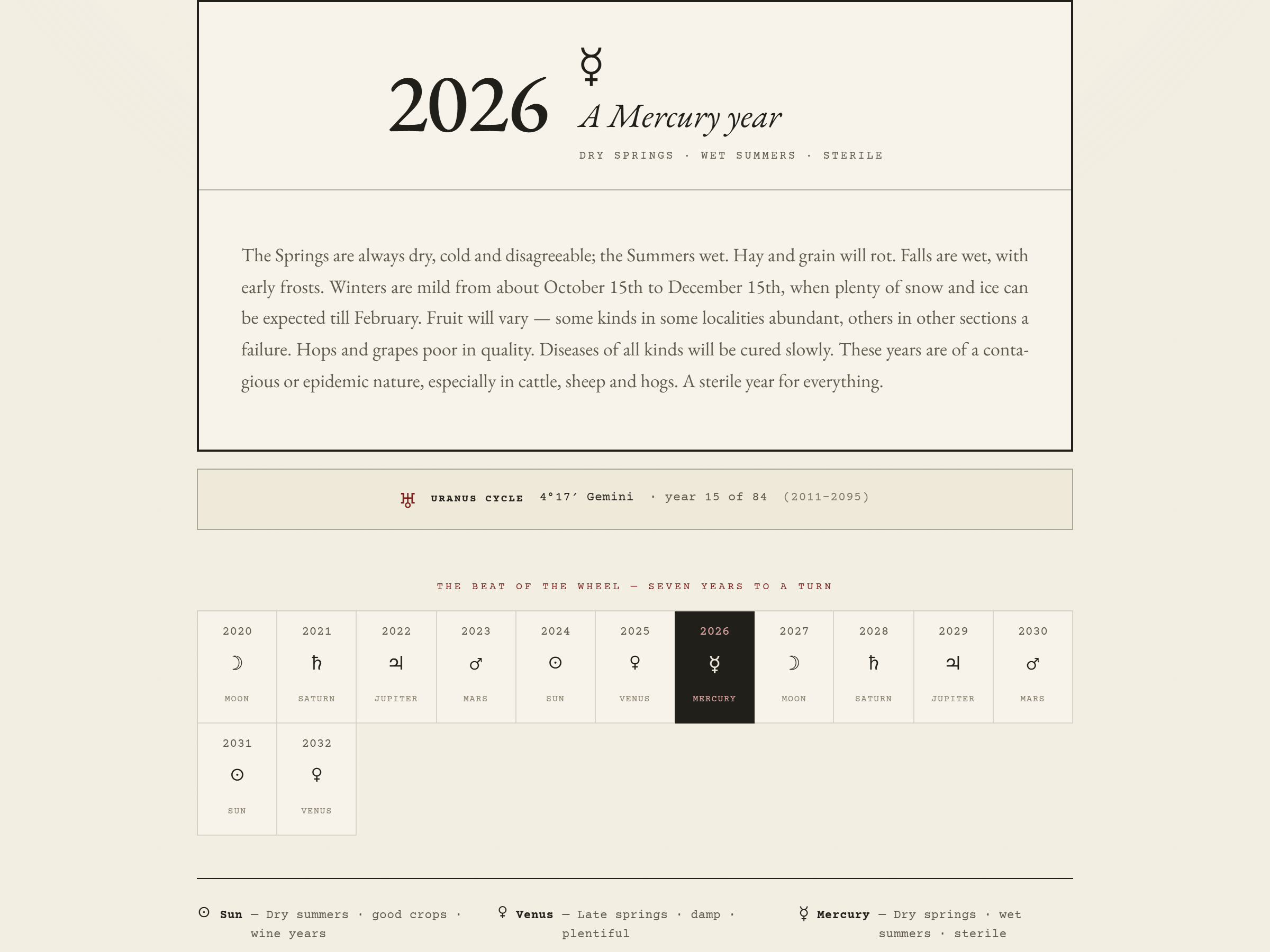
2016, derived from the tables in sequence: extreme tension in international diplomacy — fragile attempts at order, broken by sudden violent disruption. Then, and only then, the record. Brexit. The Syrian crisis. The U.S. election.
2020, same sequence: protective control asserted over populations inside their homes. Then the record. That March, governments worldwide ordered people indoors and kept them there for months. Home became the legal boundary. The protective rationale was stated out loud.
2024, same sequence: subterranean conflict over debt, resources and power breaking surface and escalating into international crisis. The record: Gaza, Ukraine, election-year institutional pressure across four continents. This is also the loosest of the three, and the walkthrough says so — "major international crises" is a wide net to cast over any year, and a reading you cannot fail is a reading that proves nothing.
The tables are the cheap part. They have been public since 1929 and cost about the price of a paperback. The order is the product.
Which is why the book defeats almost everyone who buys it. You can hold every table Sepharial ever printed and still not know which one constrains which, or what to do when two of them disagree. Four years is what it took me to answer those two questions. Here is one thing the answer surfaces.
Subtract 432 from the phase that ran 1945 to 1981 and you land on 1513 to 1549. Go and read it. England breaks with Rome. The monasteries are dissolved. Thirty thousand commoners march on the crown in the Pilgrimage of Grace. Mass movement against established authority — four centuries before anyone had the phrase for it, and carried by different nations entirely. That is the kind of structural echo the framework is built to surface, and Part 2 walks both windows against the record so you can judge how much of the resemblance is structure and how much is your eye finding what it wants.
Built for this method and nothing else. The Cycle Builder alone spans 1 BCE to 2485 CE — you enter a year and it returns the whole grid, instead of you drawing it out by hand and losing the afternoon to arithmetic before you have anything to interpret.
The method reads the rising sign, the planetary rulers, and the country charts of a year. Strip those rules out of context and they become a horoscope meme. The work stops being an instrument and turns into a parlour trick that gets quoted wrong for a decade. That is the damage open distribution does to a study like this.
You are not buying a forecast. You are acquiring the reading method itself. Once you can locate the era, name the planetary rulers, and compare the 432-year echo, you produce your own readings for any year the framework covers. That capability does not expire. No subscription. No annual renewal. The method is yours once you can apply it.
Enrolment enters manual review. You submit an NDA and a verification photo — your face beside your government photo ID — through the secure portal. The NDA covers no redistribution, no public teaching, and no resale. A team member checks each submission by hand, and access is released once you are approved.
The refund clause: If for any reason we cannot verify your identity, no access is released and we work with you directly to resolve it. The verification gate is the point at which access is granted — no change-of-mind refunds once access is released. This does not limit your rights under the Australian Consumer Law.
Some of these are uncomfortable. I would rather you read them here than discover them afterwards and feel sold to.
The worst of it is already at the top of this page — the 1917 book, the Annie Besant miss — sitting above the three worked years rather than below them, so you had to read it before you read anything flattering. That placement is deliberate. Down here is where sales copy hides things. What follows is everything else a careful reader raises, in roughly the order they raise it. Several of these answers cost me the sale. I would rather lose it now than after you have paid.
He did, and I listed the limitations at the top of this page rather than waiting for you to find them. He is not on the syllabus because he was an infallible predictor. He is on it because he left a structure — a base unit, the arithmetic that ties it together, and a set of tables — and structures can be built, tested, and found wanting in a way that predictions cannot. If a person's forecasting record were the only test of whether a framework deserved study, almost no one in this field would survive it, including the people with better marketing.
It is his, and you can check it without buying anything. It is in Hebrew Astrology, published by W. Foulsham & Co. in 1929 and reissued in 1965 as The World Horoscope. He calls 36 a "solar period," derives it, and states the arithmetic that links it to a 2,520-year span and to 432. Read the book first if you want — it is not rare and it is not expensive. What the book does not contain is the order you read the tables in, and that gap is what the course exists to close.
No, and I want to be exact about this because the phrase "36-year cycle" invites the wrong idea. In Sepharial's own scheme 36 is a unit of measure, not a metronome. His worked chronology spaces its intervals at varying multiples of that unit — the multiplier moves. Anyone selling you a tidy thirty-six-year clock that ticks over on schedule has either not read the source or is hoping you will not.
Not under blind, controlled, pre-registered conditions — not this framework and not any other forecasting method in this tradition. I am not aware of a single such study, by a supporter or a critic. The largest survey I know of is Roger Culver and Philip Ianna's, in Astrology: True or False? A Scientific Evaluation — they went through several thousand specific predictions published in astrological magazines over a five-year stretch and found roughly one in ten came true. You should hold that number in your head while you study, and the course is built so that you can generate your own results and judge them against it rather than against my enthusiasm.
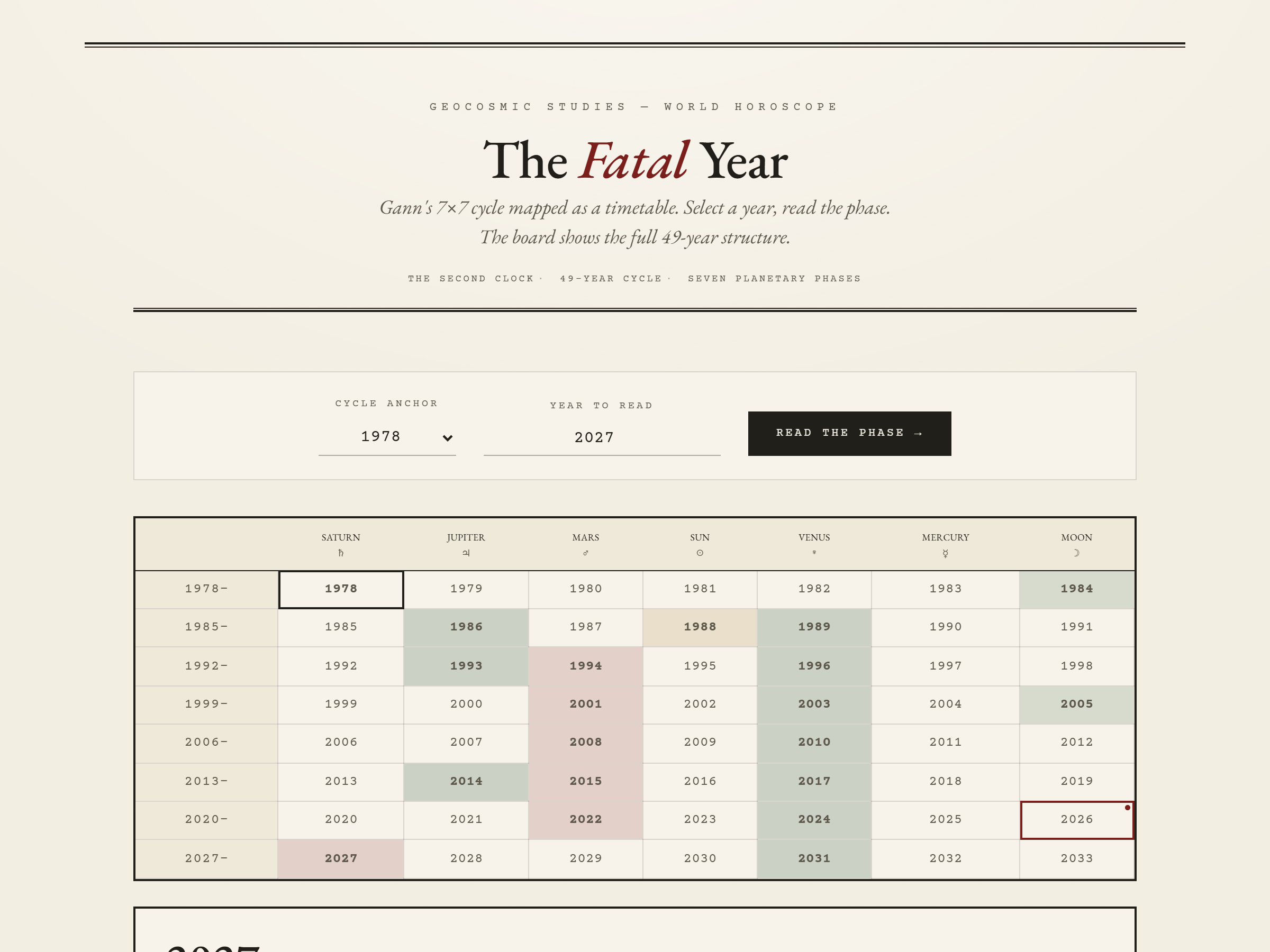
There is no evidence he did, and I have looked. Sepharial's name does not appear in Gann's commodity course or in Tunnel Thru the Air. They were contemporaries working in an overlapping tradition, and that is the honest extent of the connection. The 49-year interval taught in Part 4 is Gann's own — he wrote that seven times seven produces "the fatal evil year" — and it is taught here as a second, independent reading, not as something he inherited from Sepharial.
No. That capitalised label is later packaging by people selling Gann courses, and you will see it treated as a quotation all over the internet. What Gann actually wrote is that seven is "a fatal number… which brings about contraction, depression and panics," and that seven times seven gives forty-nine, "the fatal evil year." The idea is genuinely his. The brand name is not, and I would rather teach you the distinction than repeat the marketing.
No. Part 1 builds the framework from nothing — the ordering system, the rulership scheme, and how a chart for a year is assembled. If you already have the background you can move quickly; if you have none you are not disadvantaged, because almost nobody arrives having read the source properly. Twenty-five lessons across six parts, and a graded exam at the end of every part, because I would rather know you can run the method than assume you watched it.

This course does not issue forecasts and this page does not contain one. It teaches you to construct a reading and to judge how much weight it deserves. If what you want is a name and a date, you want a different product and I would rather you bought it elsewhere.
Nothing here is financial advice, nothing is a recommendation to buy or sell anything, and no part of the method names a security. It is a study of long-range climate, not an entry system.
It is not proven, in the sense a scientist would use the word. If you are unwilling to study something that has never passed a blind test, that is an entirely reasonable position and you should act on it.
The tables are built by you, in the sheet, alongside the lessons. Watching the videos with the sheet closed produces an impression rather than a method, and the fault will not be the material's.
A video course with the Google Sheet cycle tools and the audiobook of Sepharial's original 1929 source text. Each part adds one layer of the reading — era, year, nation, 432-year repeat, the 49-year clock, the symbolic cross-check — until you hold the complete method.
Not that you will be right more often. That you will know why you think what you think, and be able to show your working to someone who disagrees with you.
Leave it, and nothing dramatic happens. That is the problem. Every era you form a view about stays a view you inherited from someone else's summary, and you go on having no way to tell a careful reading from a merely confident one. The gap never announces itself. It just widens quietly, for as long as you leave it alone.
The mechanics, plainly. Six parts, twenty-five lessons, a graded exam closing every part. The three Google Sheet tools. The audiobook of the 1929 source text. One payment, lifetime access, every future refinement included at no further cost.
Enrolment process — After payment, complete a two-minute identity check via Stripe (government ID + selfie) and sign a non-disclosure agreement. Course access is issued after both are reviewed.
Enrol — AUD $997 →Identity check and NDA required before access is released · no change-of-mind refunds once access is released. This does not limit your rights under the Australian Consumer Law.