Sepharial, 1929 The source reconstructed
Yours for life After verification
No signals A method, not alerts
1945 · 1981 Prior phase turns, worked in full
1929 The source text

Learn the reading order behind Sepharial's World Horoscope.

The source text contains the tables for a 36-year world-cycle framework, but it does not explain which table to use first or how to handle disagreement between them. This letter explains the working sequence, the dated record used for study, and the places where the framework did not hold.

You found Sepharial the way most serious researchers do. A reference in a Gann text. A footnote in a financial-astrology book. A mention of a system that reads world history in 36-year spans — naming which nation dominates, which social force rises, what kind of pressure an era sustains. Whoever mentioned it probably called it a 36-year cycle. It is not one, and I will come back to that, because getting it wrong is the fastest way to waste a year. But the idea stayed, because the record attached to it was too specific to dismiss. So you went looking for the source.

The source is Sepharial's 1929 book Hebrew Astrology, published the year he died and reissued in 1965 as The World Horoscope, which is where this course takes its name. It maps each 36-year era to a sign, a ruler, and a set of themes. What it never states is the order you read them in — and that gap is why most people who buy the book never get a single reading out of it.

Take one era the book characterises: the phase running from 1945 to 1981. The Cold War. Suez. Pan-Arab nationalism. Independence movements across Africa and Asia. The end of the British Empire. Much of what the 1929 text says about that phase ran in the record — not all of it, and the course shows you which parts did not.

The trouble is the source itself. The book is written for readers who already knew the Chaldean planetary order, Hebrew notation, and century-spanning tables that carry no legend. Most researchers stop at page ten. The ones who push through finish with a sense of the system and no working procedure for running it. The method was sound. The way in was buried in a language almost nobody reads. This letter is about finding the working order — and the tools that make the method run for any year the framework covers.
Before you continue

Decide quickly whether this is the right course for you.

This is a research method for reading long-range world climate. It is not a news service and it does not provide specific event calls.

You learn

How to read Sepharial's 36-year cycle in order: era, year, nation, and the second timing layer.

Proof to inspect

Three dated retrospective demonstrations, each derived before the historical record is checked.

Important limit

The examples demonstrate the procedure. They are not proof of future event certainty.

Terms

AUD $997 once. Lifetime access after identity verification and an NDA. No change-of-mind refund after access; Australian Consumer Law rights remain.

Enrol in the course Buy the reading method, not a forecast feed.
§ The broken tool · Problem mechanism

News explains the event. This method studies the longer cycle around it.

Every crisis has two layers. There is the event — the invasion, the election, the default, the crash. And there is the era the event grew inside — the 36-year backdrop that made the event structurally probable. Standard analysis is excellent at the first layer. It names the event, assigns causes, and reads the damage. The second layer is invisible to it. The era that made the event probable is not visible in the news, in economic data, or in the political record. It is visible only in the world cycle — and the cycle shows you the backdrop before the event fills it.

The course works closed historical years end to end — the chart assembled first, the record consulted second, in that order and never the reverse. Some of them read tightly. Some do not, and those are in there too, because a worked example that always succeeds is a sales demonstration rather than a lesson. None of these readings predicted a specific event. They named the character of a year and the type of event that character favours. That is a different instrument from the one that reads events after they happen.

There is only one place that instrument was written down. Sepharial mapped it in 1929, measured in 36-year spans and anchored to the Chaldean order. But the source is nearly unreadable. Written in Cambridge-scholar notation for readers who already held the system cold, it uses coded planetary markers and century-spanning tables with no legend. The method survived. The working order was lost. Four layers of the system sit in public domain and stay unread, because almost nobody finds the sequence that makes them run.

A standard chart explains what happened. This method adds the longer cycle that was active during that year.

Four gaps break almost every attempt at this system. They are the same four every time.

01

No era context

Every event has a backdrop. The era running from 1945 to 1981 has one character; the era before it has another. Every move inside a period runs against that backdrop. Without that backdrop, each event looks isolated. With it, the events become expressions of the era — which means the type of event was probable before the specific one arrived.

02

No 432-year map

The same era echoes on a longer span built from Sepharial's own 36-year unit. The course pairs one such window with a comparable one from centuries earlier and walks both against the record, so you can judge for yourself how much of the resemblance is structure and how much is the eye finding what it wants. Modern analysis treats each decade as unprecedented. The world cycle treats it as one of several times this combination has run. Historical repeats give you what the current record cannot: structural depth.

03

No country forecast

Each nation governs a zodiac sign. When a year's rising sign matches a country's sign, that nation carries the year's story. Without country charts, the world cycle gives you a global climate but no named actor. With them, the forecast narrows from "a year of structural tension" to "a year of structural tension running through this nation" — before the headlines decide which one.

04

No second clock

The 49-year interval Gann called "the fatal evil year" runs independently. When the world cycle's inflection falls near a 49-year marker, two independent systems point at the same window. One reading is an interpretation. Two independent clocks pointing at the same year is a reason to study it seriously. Without the second clock, the world cycle gives you one signal. Together, they give you convergence or contradiction — which is itself information.

A working reading goes in order, and the order is not negotiable. Era first: the 36-year phase and its ruler. Then the year, and the kind of pressure it favours. Then the nation the year runs through. Then the second clock, and whether it converges anywhere nearby. Get that sequence wrong and you are not reading the framework, you are decorating a conclusion you already had. Here is how each layer is built.

§ The method — built in five layers

The source has five layers. The course teaches their sequence.

Sepharial's book has been in print since 1929. The working order for reading it has not. What follows is the sequence that turns five coded tables into a reading you can run on any year the framework covers.

The book worked. The way in did not. Four years to find the difference.

I spent four years with the 1929 text. It is written in Cambridge-scholar language — Hebrew planetary notation, coded tables that span centuries, assumptions on every page that the reader already knows the Chaldean order cold. Most researchers stop at page ten. I nearly did. What kept me was the record. Every claim the book made, I checked. The 1929 text characterises the phase running from 1945 to 1981 and assigns it a set of nations. I checked that characterisation against what actually happened. Enough of it landed that I kept going — not all of it, and the course shows you which parts did not.

So the method was sound. The problem was the order. Each reading took an afternoon of hand calculation before I had anything to interpret. The work was all setup and nothing else. I kept asking: in what sequence does this book want to be read? Not "is the system true?" — the historical record was answering that. "What is the working order?" That question took longer than the verification.

The day it clicked, I stopped reading the book as vague predictions and started reading it as structural cycle logic. Era first. Year second. Nation third. The 49-year clock fourth. Read in that sequence, the coded tables stop being a wall and start being a procedure. Once I held the order, I could build the tools to run a reading in minutes instead of an afternoon. The work moved from calculation to interpretation — which is where the real study lives. Those tools became this course. What follows is the same sequence, taught the way I would teach a research partner.

1

The era — the 36-year phase

Every era carries a ruler, and the ruler's character sets the era's theme. Take the closed phase running from 1945 to 1981. It reads as mass movements and popular power — public sentiment as the dominant force. Then check it: the labour era, decolonisation, the civil rights decades, the end of empire. The phases either side of it read differently, and the course works those as closed cases too. What I will not do is hand you a reading of the phase you are standing in right now. That one is not closed, and a page like this is the wrong place to publish it. You learn to locate your own phase, name its ruler, and find the prior periods that carry the same structure — the derivation logic and the historical pairings are taught inside the course, because they are the course.

The first layer identifies the main theme of the era and the ruler used to calculate it.
2

The year — its world horoscope

Inside the era, each year has its own world horoscope: a rising sign, planetary rulers, and a 12-house structure. The rising sign sets the year's theme. The ruler of the sign determines the type of pressure the year favours — structure, conflict, expansion, dissolution. The 1939 world horoscope reads as emotional upheaval, domestic disruption and the mass movement of people. Poland was invaded in September. The 1914 chart reads as a breakdown of communication and the destruction of human relationships. War came in August. You learn to build the world horoscope for any year the framework covers and read its structure before the events that express it arrive.

The rising sign identifies the year's main theme and the type of pressure most likely to appear in that twelve-month period.
3

The nation — the country chart

Each nation answers to one sign. Which nation answers to which is the lookup you build in Part 3 — and it is the step where most self-taught readings quietly go wrong, because an error there corrupts every country reading you make afterwards without ever announcing itself. When a year's rising sign matches a nation's governing sign, that nation is spotlit and carries the year's story. You learn the spotlight check: which nation's sign is prominent in this year's world horoscope, and what that activation historically produces. The country-chart table is inside the course. What you carry out is the ability to run the check and name the nation before the year writes its record.

4

The 432-year repeat — history as the research instrument

Built on Sepharial's own 36-year unit, the same structural theme echoes on a much longer span — centuries apart, same character, different nations carrying it. Subtract 432 from the window that ran 1945 to 1981 and you land on 1513 to 1549 — England's break with Rome, the dissolution of the monasteries, thirty thousand commoners marching on the crown in the Pilgrimage of Grace. The same underlying tension between mass movement and established authority, carried by different nations and expressed in entirely different events. You learn to use the earlier period as a research document — not because history repeats identically, but because the structural echo tells you what kind of events a phase favours long before they happen. The full derivation and the historical pairing are worked in Part 2, so several centuries of documented record become part of your reading before you look at a single news headline.

5

The 49-Year Clock — the second clock

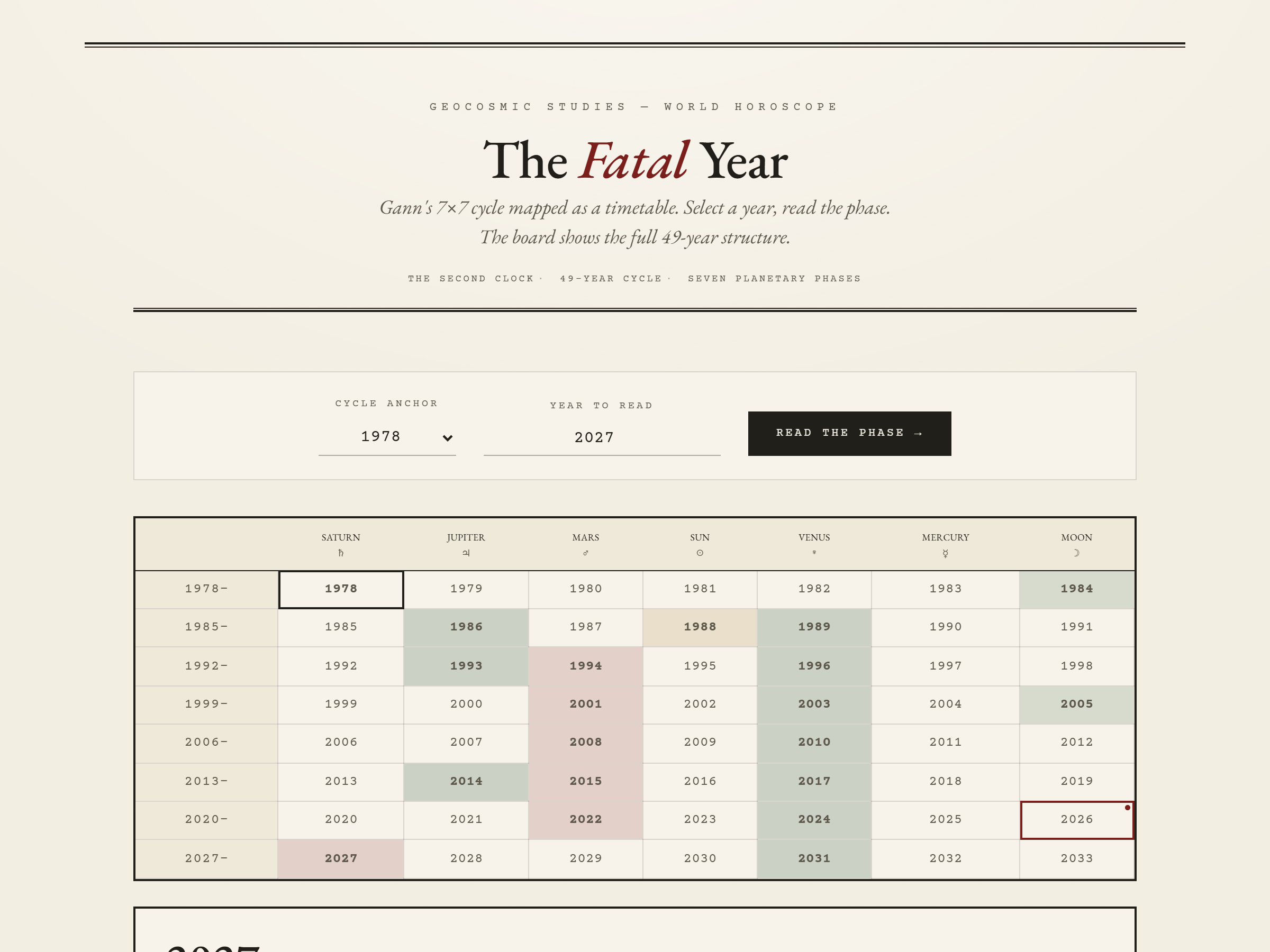
Gann's 49-year cycle — the square of seven, 7×7 — runs independently of the 36-year solar period. It is not a trading signal. It is a count of years at which structural pressure concentrates, and Part 4 anchors the modern count at the 1974 low and runs it to its close in 2023.

Here is why that matters. One clock reading a year is an interpretation. Two clocks, built on unrelated arithmetic, landing on the same window is a reason to go and look. Used alone, the 49-year count gives you a vague strain period. Used beside the world cycle, it gives you confirmation — or contradiction, which is just as useful and considerably more honest.

But there is a catch, and Part 4 puts it in front of you rather than behind you. A convergence is a window worth studying. It is not a prediction of a specific event, and treating it as one is the single fastest way to ruin this method. So you learn the check itself: run it on any year the framework covers, hold the comparable historical windows and the kind of pressure they produced as your reference, and decide for yourself how much weight the year deserves — before the year makes its own case.

The course compares the 49-year count with the longer world cycle. When their windows overlap, you have a stronger historical case to test.
§ The proof walk

Build the reading first. Check the historical record second.

Five cases follow, and not one of them is a live call the Skool published at the time. I would rather say that here than have you find it in a footnote afterwards. One is a historical illustration of how the system reads an era at scale. One is a backtest. Three are course demonstrations, assembled after the events in the same derivation order a live reading would follow. None of them proves a future call. All of them show why the framework earns serious study. Read each with its limit attached — that is how the method is taught.

And before any of it, the thing that should make you suspicious of me. With the Great War still running, Sepharial published a book called Why the War Will End in 1917. The war ended on 11 November 1918. Earlier he had predicted that Annie Besant would die in 1907; she lived until 1933. The Theosophical Society's own encyclopaedia still records Alan Leo's remark to her afterwards — that by failing to die on schedule she had knocked the bottom out of English astrology. So I am asking you to study a man who is on the record missing, in print, twice.

The reason is narrow, and it is the whole argument of this letter. He did not leave a set of predictions. He left a structure. A prediction you can only swallow or reject. A structure you can build, run against a closed year, and break — and I would rather hand you something breakable. Read the cases below with that in your hand.

1929–1981
Historical illustration · a closed phase, worked in full

What the 1929 text actually contains: a base unit of 36 years, the arithmetic tying it to a 2,520-year span and to 432, and a set of tables. No reading order.

Take the phase running from 1945 to 1981. The 1929 text characterises it as an era of mass movements and popular power, and assigns it a ruler and a set of nations. What followed is a matter of record: the Cold War, the space race, Suez and pan-Arab nationalism, independence movements across Africa and Asia. The labour union era rose and peaked across the West. The British Empire — which the framework places opposite the era's own rulership, and so expects to be unwound by it — declined and ended. Much of what the 1929 structure characterises ran in the historical record from 1945 to 1981. Not all of it. Part 2 works the misses too. The Skool did not publish this call — Sepharial did. This is a teaching illustration, not a forecast the desk made at the time. The point is that the system read 36 years of world history from first-principles planetary structure, before the events that confirmed it.

1974–2023
Backtest · the second clock, one full count

Anchor the count at the 1974 low. Forty-nine years later it closes in 2023. Six strain years fall inside it — and you can check every one against a chart you already own.

Gann's 49 is seven sevens, and the count only means anything once you fix where it starts. Part 4 starts it at the generational low of 1974. Run the sub-divisions forward and six strain years fall out: 1987, 1994, 2001, 2008, 2015, 2022. Then go and look. October 1987. The dot-com unwind in 2001. Subprime in 2008. The 2022 equities decline. Now the part that should slow you down, because this is the case on the page most likely to be oversold. The count is fitted to a low chosen after the fact, six markers across half a century is a small sample, and every one of those years had causes a historian can name without any of this. The clustering is real. It is not a machine. A strain year is a window to go and test, never a date to trade, and the course teaches it with that restraint bolted on — because the cluster is convincing enough to make a careless reader reckless.

2016
Course demonstration · World Horoscope

The 2016 chart derived one synthesis: extreme tension in international diplomacy, fragile attempts at order threatened by sudden violent disruption. Derived first — then checked.

The 2016 world horoscope, assembled in the order Part 2 teaches, points at extreme tension in international diplomacy — fragile attempts at order threatened by sudden, violent disruption. The events of that year — the Brexit vote, the Syrian crisis, the U.S. election — each expressed that dynamic on the world stage. This is a retrospective teaching demonstration, built after the events, walked in class in the same derivation order a live reading would follow. The Skool was not publishing course readings in 2016; this shows the method in use, not a call made at the time.

2020
Course demonstration · World Horoscope

The 2020 chart derived one synthesis: protective control over the masses in their homes.

The 2020 world horoscope pointed at themes of home, protection, and the collective. The derived synthesis: a year of protective control over populations in their homes, with government authority acting through that lens. In March 2020, governments worldwide ordered populations indoors. Home became the legal boundary. The protective rationale was explicit. This is a retrospective teaching demonstration, built after the events — the Skool was not publishing course readings in 2020 — walked in class the same way a live reading is built, so you can see the derivation, not just the outcome.

2024
Course demonstration · World Horoscope

The 2024 chart derived one synthesis: deep-seated conflicts over debt, resources, and power erupting aggressively onto the world stage.

The 2024 chart, assembled in the same order, points at subterranean conflicts over debt, territory, and power breaking surface and escalating into major international crises. The record: Gaza, Ukraine, election-year institutional pressure across four continents. This is a retrospective teaching demonstration, built with the year's events already public. The course walks the student through producing this kind of synthesis in the same derivation order — then testing it against what actually happened — not through a call made before the year unfolded.

The synthesis is derived from the planetary structure. The record is checked after. That sequence — derive first, test after — is the discipline the course teaches.
Event-only analysis

You name the event and lose the era it grew from.

  • The crisis, named after it lands
  • Each decade read as unprecedented
  • No nation forecast, only reaction
  • No structural repeat to research
  • No second clock, no convergence
With the world cycle

You read the era and the nation before the decade names itself.

  • The era named from planetary structure
  • 432-year repeat as a research document
  • Country chart gives the spotlight nation
  • Prior period shows what the phase favours
  • The 49-year clock confirms or contradicts the window
If you have read this far

Three worked years — 2016, 2020 and 2024 — built in sequence and then checked.

Some readers have enough already. If derive-first-check-after is the discipline you came for, you can enrol here, and nothing below this line makes the offer cheaper. Everything below is for the reader who wants the five layers unpacked, the biggest objection met head-on, and the eight hardest questions answered before spending a dollar.

AUD $997 · One payment · Lifetime access · NDA and ID verification on enrolment

§ See inside

The course teaches the structure, not a legend.

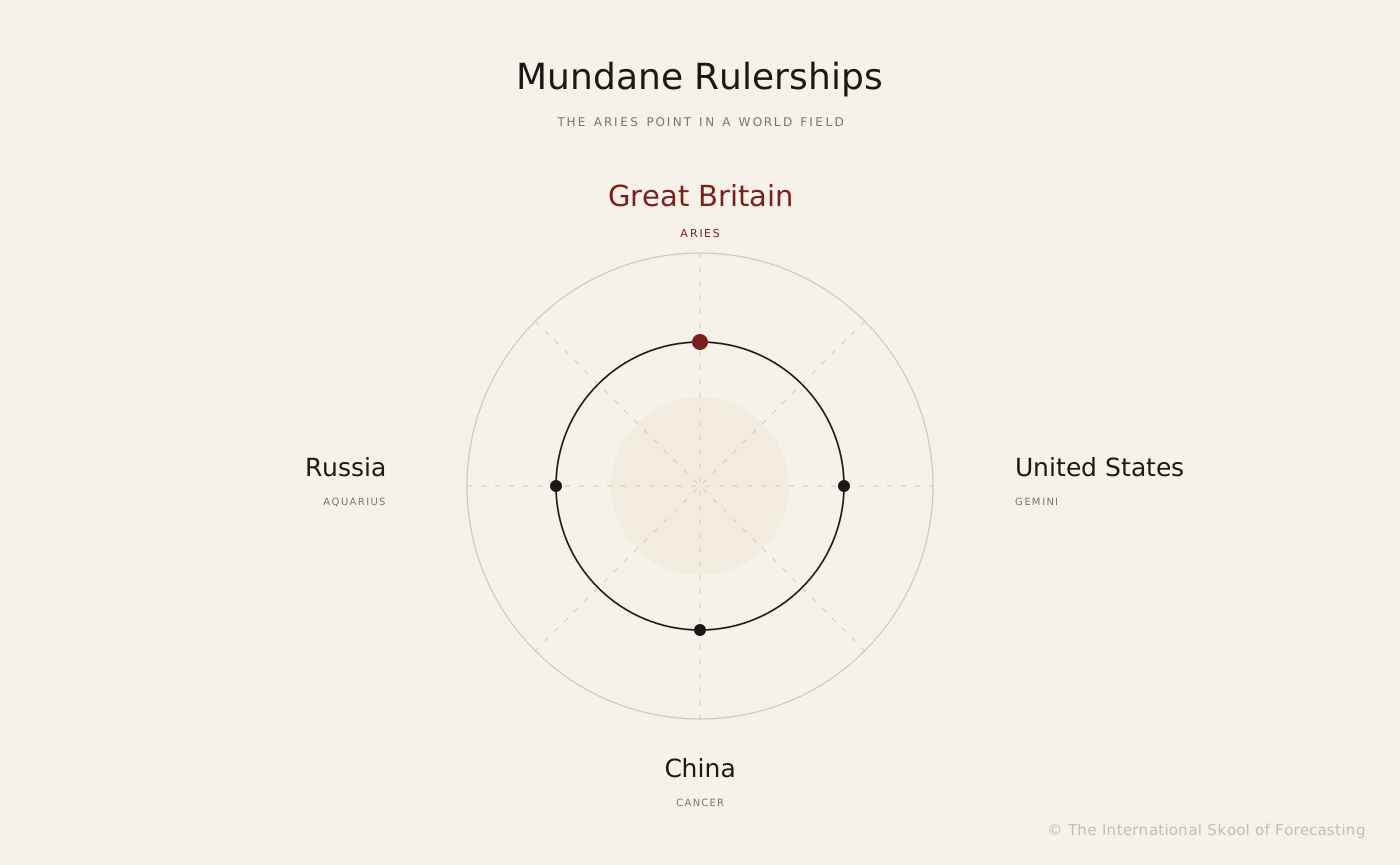
This is the national rulership field as it appears in Part 3 — the geometry, the four positions, the one that carries the year. What the plate deliberately does not carry is the legend: which nation answers to which rulership. That table is the product, and it stays inside the course.

Method plate: the national rulership field, showing the four field positions with the rulership legend withheld
Method plate · the national rulership field
§ "But this is just astrology"

The method asks you to test a timing framework, not accept a belief.

You see the word horoscope and you reach for the exit. So do I, when it is sold as fortune-telling. A serious forecaster should not accept a model because it sounds impressive. The model has to be tested against time. If it cannot survive a check against the record, it does not belong in your study, and no amount of old language saves it.

A historical model is not accepted because it sounds impressive. It has to be tested against time, with enough restraint that you do not force every headline into it.

Here is what the method actually is. It is history organised as recurring timing structure. The planetary names are the labels Sepharial used; the work is the pattern they point to. A 36-year era. A yearly theme. A national chart. You compare the present phase with prior comparable phases and ask what type of developments appeared. That question is falsifiable. It is also the same question whether the year is 1945 or 2024.

Strip the old vocabulary and the procedure is plain. You are sorting history into a repeating frame and asking what tends to happen at this position in the frame. The labels could be anything. Sepharial used planetary names because that was the notation of his tradition. You could rename every term tomorrow and the method would run unchanged, because the work is in the comparison, not in the words. That is the test of whether something is timing structure or fortune-telling. Fortune-telling does not survive a rename. This does.

The course organises historical dates into recurring periods and teaches you how to test the pattern instead of memorising rules.

So the modern market does not break the method. It is one more period to read — and you test the framework against a live window exactly the way you test it against a closed one. Derive first. Check after. The order is the discipline, and it is the only thing standing between a reading and a rationalisation.

§ Why now

1945 opened a phase. 1981 opened the next. The course teaches you to locate the boundaries yourself.

There is no manufactured deadline on this page and no countdown. The course will teach the same method next year that it teaches today.

I publish no forecast on this page, and that is deliberate rather than coy: a dated call asks you to trust a number instead of a method, and it is the number that expires. The two prior comparable turns — 1945 and 1981 — are worked in full inside the course, as closed cases with the record attached. The researcher who held the framework before 1945 watched that era open. The one who held it before 1981 watched it close. Learning to locate that kind of turn while it is forming, rather than reading about it afterward, is the skill the course teaches — the framework works on any year you choose to run it against, past or present.

Wait and you do not get a discount. You get the same course later, after whatever window you were curious about has closed and joined the record as history instead of something you could study while it was live. The reading you did not run on a live year cannot be recovered. The question the course answers is whether you learn to read a window while it is forming, or read about it after the fact.

§ What you gain · Three instruments

The course tools make the calculations repeatable.

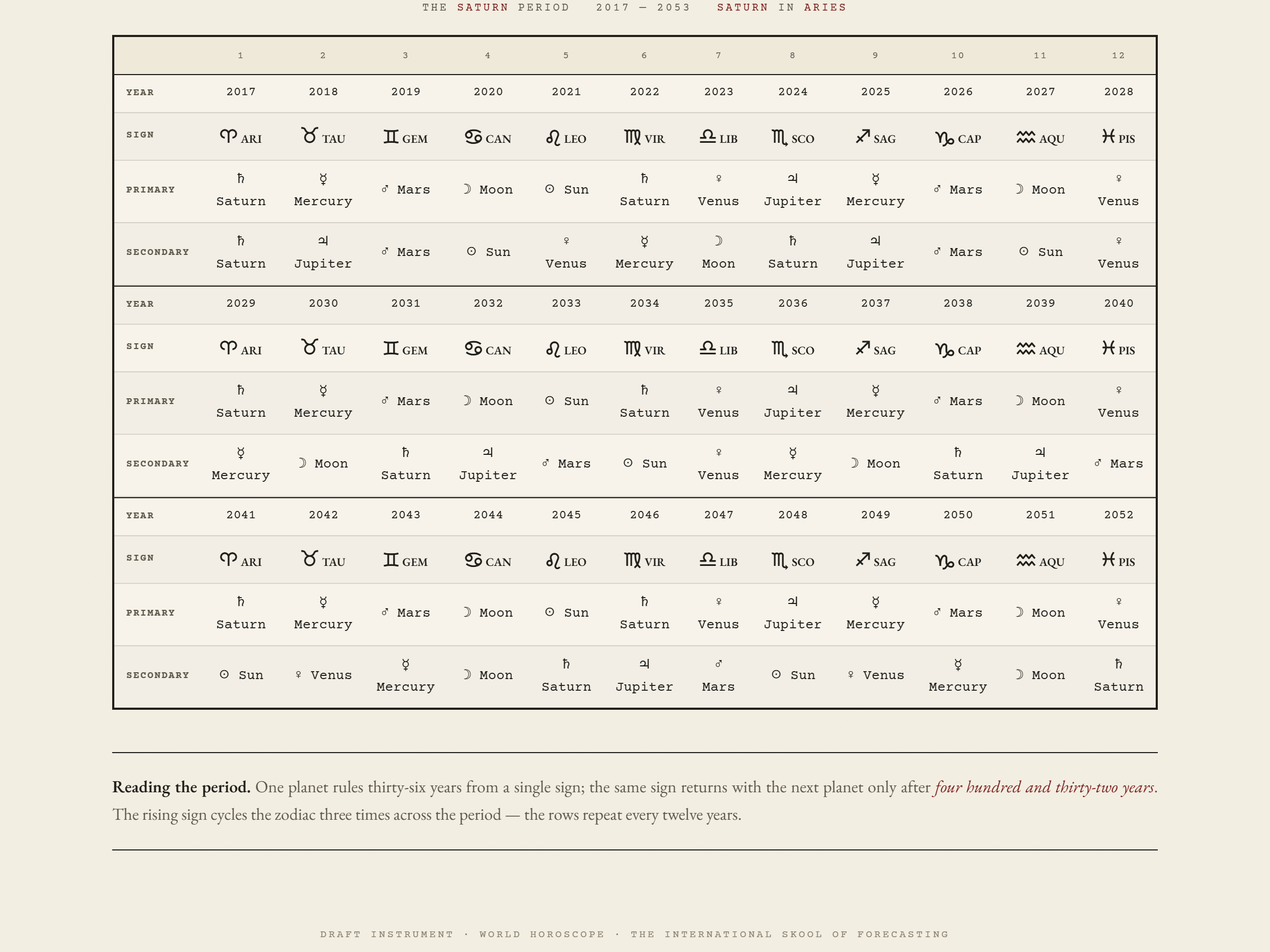
Built for this method and nothing else. The Cycle Builder alone spans 1 BCE to 2485 CE — you enter a year and it returns the whole grid, instead of you drawing it out by hand and losing the afternoon to arithmetic before you have anything to interpret.

I
The Planetary Year tool
Gated · Course

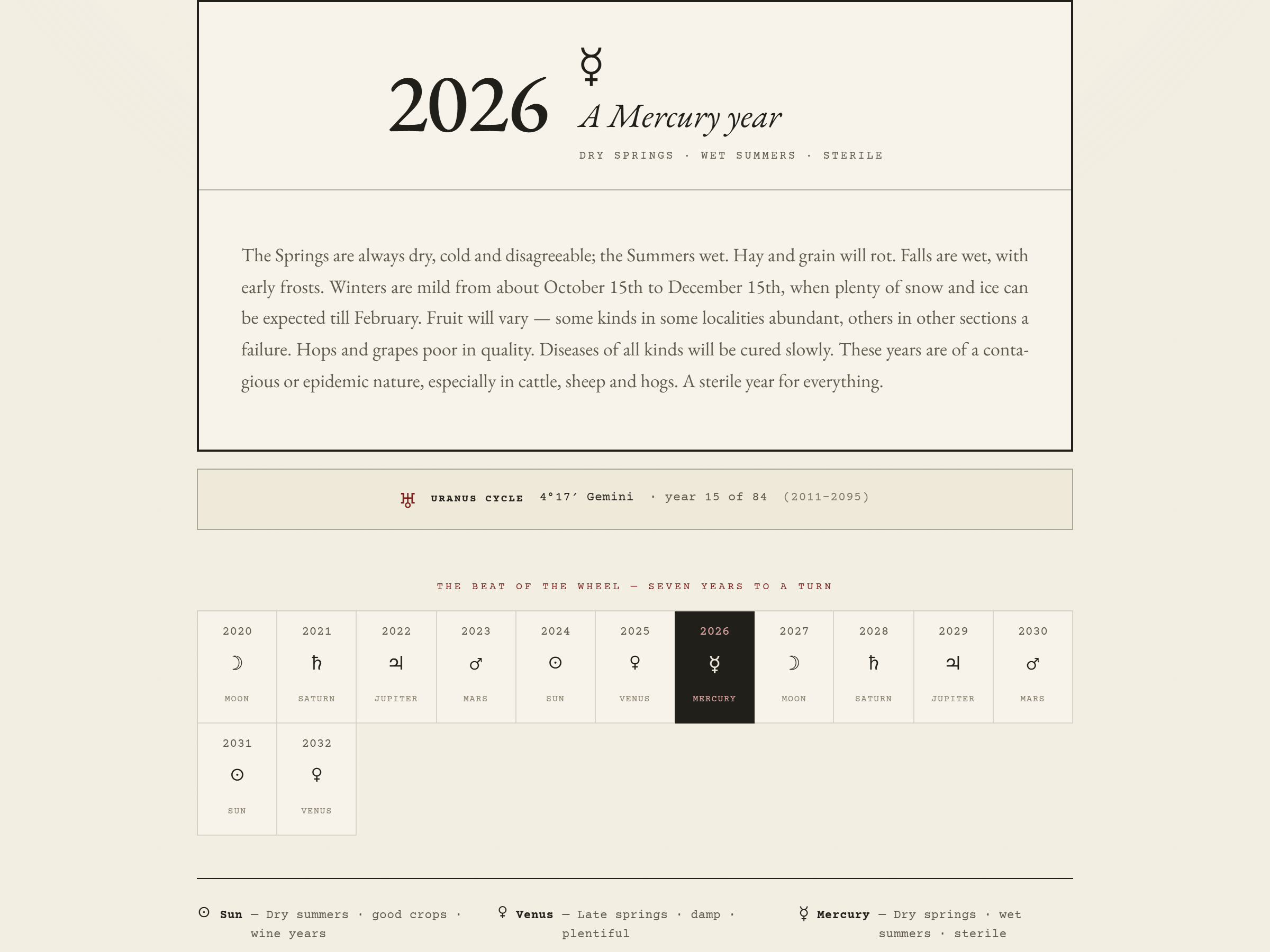
The Planetary Year


Enter a year from 1800 to 2142. The tool returns the ruling planet, the character the old texts ascribed to that reign, and the seven-year wheel centred on your chosen year.

II
The Cycle Builder tool
Gated · Course

The Cycle Builder


Enter any year from 1 BCE to 2485 CE. The tool builds the complete 36-year period grid — rising sign, primary and secondary rulers for all 36 years — plus the yearly and country chart panels.

III
The 49-Year Clock tool
Gated · Course

The 49-Year Clock


Gann's 49-year (7×7) cycle mapped as a timetable. Select a year, read its phase. The board shows the full cycle colour-coded by phase — death years in crimson, bull phases in green.

§ Why this is gated

The reading rules are the product you are buying.

The rules behind this reading — the rising-sign legend, the rulership table, the country charts — are the product. Pull them out of context and they stop being an instrument. They become a horoscope meme, quoted wrong for a decade by people who never read the source.

Here is why that matters more than it sounds. A table without the method around it is worse than useless. It looks like the answer, and it is only the labels. Someone reads four rows, posts them, and the next thousand people meet this framework as a screenshot instead of a study.

And there is a second reason, less noble and worth saying out loud. Once the rules are loose, they are loose for everyone — including the student who paid for the working order and now owns something anybody can get for free. Gating is how what you bought stays worth buying.

You are not buying a forecast. You are learning to read the phase yourself. Once you can locate the era, name the rulers, and run the country check, no one needs to read the year for you again. That skill stays with you for the rest of your study. A subscription rents you someone else's reading and stops the day you stop paying. This is the opposite trade. You learn the instrument once and you keep it for every year the record and the cycle reach. The cost is paid once. The capability does not expire.

Enrolment enters manual review. You submit an NDA and a verification photo — your face beside your government photo ID — through the secure portal, and a team member checks it by hand. The NDA covers no redistribution, no public teaching, and no resale. Access is released once you are approved.

The material is not distributed anonymously. Every student in this program has been verified. You will be too.

The refund clause: If for any reason we cannot verify your identity, no access is released and we work with you directly to resolve it. No change-of-mind refunds once access is released. This does not limit your rights under the Australian Consumer Law. The verification gate is the only point at which money moves backwards.

§ Six parts — what you build

Each part teaches one layer. By the end you can run the full reading yourself.

The parts stack. The era feeds the year. The year feeds the nation. The 49-Year Clock is the second clock you read beside all of it.

The instructor · how this course came to exist

The order is in the letter above. What a letter cannot give you is watching someone use it.

You now have the sequence — era, year, nation, second clock. Knowing it is not the same as running it. In my first year with the book, most afternoons ended in a result I did not trust, and no way to tell whether the fault was in the framework or in me. That is the gap the video closes, and it is the only honest reason to pay for a course about a public-domain text.

So in the course you watch the readings get built on screen. Where I hesitate. Which layer I let override which when two of them disagree. Where I decide a reading is too loose to keep and say so out loud. The judgement is the part no book gives you — and, frankly, the part I could not have written down if I tried.

I teach it now because the framework is wasted in a drawer, and because most people who meet the book give up at page ten. The honest answer is that it deserves serious students, and serious students deserve the working order, not just the source. I am not handing you a forecast. I am handing you the way I build one.

Part 1

The foundations of the system

You start where Sepharial started. The Chaldean order, the planetary rulers, and the shape of the 36-year framework. By the end you can read the notation the source uses instead of bouncing off it. This is the ground every later layer stands on.

  • The source notation, decoded for use
  • The audiobook of Sepharial's 1929 text
  • A working map of the framework's structure
Part 2

The 36-year cycle

You learn to locate the era you are standing in and the prior periods that rhyme with it. You compare comparable phases and ask what type of pressure appeared. The output is a reading of the climate, which becomes the input for every yearly read that follows.

  • The phase map across the framework’s span
  • The comparison method for prior eras
  • The Google Sheet cycle builder
Part 3

Yearly and country cycles

You take a single year and read its rising sign and rulers. Then you run the spotlight check: does the year's sign match a nation's sign? You walk real years yourself, document the reading, and keep a record you can defend rather than a claim you take on faith.

  • The yearly reading procedure
  • The country-cycle tools
  • Your own documented yearly readings
Part 4

Advanced systems — planetary dignities and the second clock

This part does not appear elsewhere in plain form. You learn planetary dignities, then Gann's 7×7 cycle as a second clock read beside the 36-year rhythm, then the hidden numerical and alphabetical patterns inside Sepharial's own writing. The 49-year clock is taught with its limits attached: used alone it gives a general idea; merged with the longer cycle it earns its keep.

  • Planetary dignities explained
  • The 49-year cycle, read with restraint, and the full count backtested from the 1974 low to its close in 2023
  • Hidden numbers and letters in Sepharial's book
Part 5

The Egyptian Tarot system

Sepharial also left a second forecasting key: an Egyptian Tarot correspondence system tied to the same framework. You learn its foundation and card correspondences as an additional interpretive layer alongside the world horoscope.

  • The Tarot system's foundation
  • Card correspondences within the framework
Part 6

Building a forecast

You combine every layer into one reading: era, year, nation, and the second clock. You run it with the report generator and produce a long-range reading you keep. This is the capability you walk away with for the rest of your study.

  • The three-layer reading procedure
  • The horoscope report generator
  • Future refinements: included as they are added
Six parts of video instruction Included
Google Sheet cycle tools and report generator Included
Audiobook of Sepharial's 1929 source text Included
You pay — once, lifetime access AUD $997
Enrol in the course No change-of-mind refunds once access is released (this does not limit your rights under the Australian Consumer Law) · identity check and NDA required first.
§ What you walk away with

Part 1 makes the 1929 text readable. Part 3 has you reading a year. Part 6 has you running the complete method.

There are no change-of-mind refunds once access is released, which does not limit your rights under the Australian Consumer Law. So at this price, the specifics are the guarantee. Here is exactly what you can do, part by part.

By Part 1
Read Sepharial's notation without bouncing off it.
You open the 1929 text and follow it. The coded planetary notation reads as structure, not a wall.
By Part 3
Read any single year and name the nation in the spotlight.
You run the rising sign, the rulers, and the country check on a year, and document the reading yourself.
By Part 6
Run the full three-layer reading forward.
You combine era, year, nation, and the 49-year clock into one long-range reading, generated with the tools and kept.
After enrolment · Yours forever
Lifetime access — including every future refinement.
All current materials, all updates added over time, all future refinements as they are produced. No subscription. No renewal. No re-purchase. Once you are verified and the NDA is on file, the course is yours for the rest of your career.
§ The two limits · Read these before you enrol

This method has two limits: it requires historical testing, and it cannot guarantee a future event.

You have seen the cases. Here is what they do not cover. Both of these are taught inside the course, and both are the kind of thing a sales page usually leaves out — which is exactly why they sit here, above the price, rather than below it.

Nothing in this tradition has ever passed a blind, controlled, pre-registered test — not this framework, and not any of its competitors. The largest survey I know of is Roger Culver and Philip Ianna's, in Astrology: True or False? A Scientific Evaluation — they went through several thousand specific predictions published in astrological magazines over a five-year stretch and found roughly one in ten came true. Hold that number in your head the whole way through. The course is built so that you generate your own results and judge them against it, rather than against my enthusiasm.

Jonathan Evans
The evidence limit
Stated in the course, not only on this page

Thirty-six is a unit of measure in Sepharial's scheme, not a metronome. His worked chronology spaces its intervals at varying multiples of that unit — the multiplier moves. Anyone selling you a tidy thirty-six-year clock that ticks over on schedule has either not read the source or is hoping that you have not. If you came to this page wanting a clock, this is the paragraph to stop at.

Jonathan Evans
The structure limit
Corrected in Part 2, before you build anything
§ Enrolment — three steps, operational

What happens after you enrol.

1

Enrol

Complete checkout via the secure page. Your enrolment immediately enters manual review. You will receive a confirmation.

2

Verify

NDA and identity verification protect the student files and the research process. Access is released after verification is complete. If verification cannot be approved, no access is released and we work with you directly to resolve it.

3

Read

Open Part 1 and the source audiobook. Then open the Google Sheet tools and generate your first yearly reading alongside the lessons. You start running the framework on day one, not after it.

§ Objections — eight questions answered directly

Eight questions, including the ones that cost me sales.

Do I need to know astrology before I start?

No. Part 1 teaches the notation and the rulers from scratch. If you can read a calendar and follow a table, you have enough. The work is pattern comparison, not belief. You are learning to read a historical frame and ask what tends to appear at a given position in it. The astrology label is the old vocabulary. The skill is comparison.

Sepharial's book is in the public domain. Why pay for this?

The book is the snapshot. The course is the working order. The text takes most readers ten pages to abandon. The course gives you the read sequence, the Google Sheet tools, and the audiobook. You spend your time interpreting instead of decoding. The book is free. The four years I spent working out the sequence are not.

Does this still work on the modern market?

The modern market is one more period to read. Part 3 runs the yearly reading on recent years, and Part 6 runs it forward. The same question — what type of events appeared in comparable phases — works whether the year is 1945 or 2024.

What if I force every headline into the framework?

That is the common failure, and the course is built against it. Part 4 teaches the 49-year clock with its limits attached, and the whole method insists you test a phase against prior comparable phases before you trust a reading. Restraint is part of the training.

Is this a signal service or a trading system?

No. It issues no alerts. It is a geopolitical and historical research method: a structured way to read the climate of a year before events fill it. It is a layer above your existing work, not a replacement for it. You name the era and the season. What you do with that context is your own judgment.

I am not a professional trader. Is this for me?

It is for the student of history who wants the widest lens. If your interest is individual near-term events, start elsewhere. If you want to understand why decades feel structurally different from one another, this belongs in your study.

What is actually original here?

Part 4. Gann's 49-year interval, taught as a second clock alongside the 36-year rhythm, with the convergence method included. The convergence — where both cycles point at the same window — is the part you will not find taught in plain form elsewhere.

How long until I can run a reading?

You generate your first yearly reading in Part 3, alongside the tools. The rest extends and refines it. Lessons are self-paced, and the working files are yours for life, so there is no clock on completion.

§ Who this is not for

Four kinds of reader will be better served somewhere else.

If you want to read the climate of a year yourself, and keep that skill for life, this is built for you — the six parts, the 49-year clock, the Google Sheet tools, and the source audiobook. You walk away able to read the era, the year, and the nation without anyone reading them for you. If any of the four situations below describe you, look elsewhere first.

If you want a signal feed.

This issues no alerts and no buy or sell calls. It is a study you run yourself. If you want someone to ping you a trade, a signal room will serve you better.

If you want a specific date or price.

The method reads a climate, not a calendar entry. It gives you the type of pressure a year favours, not "the top is the 14th." If you need certainty before you act, this will frustrate you.

If you will not study the source.

The capability lives in the readings you run, not in the videos you watch. If you will not work the framework against real years, you will leave with theory and no skill. There are no change-of-mind refunds once access is released — this does not limit your rights under the Australian Consumer Law — so weigh that honestly before you enrol.

If you need licensed financial advice.

This is education, not advice. It does not account for your situation or your portfolio. If you need personal financial counsel, see a licensed professional.

§ The decision

Six parts · twenty-five lessons

After the course, you can label the era, assess the nation, and test the next cycle phase.

You will not see the swan coming. What changes is that you already knew what colour the water was.
AUD $997
One payment · Lifetime access · NDA + identity verification

Enrolment process — After payment, complete a two-minute identity check via Stripe (government ID + selfie) and sign a non-disclosure agreement. Course access is issued after both are reviewed.

No change-of-mind refunds once access is released (this does not limit your rights under the Australian Consumer Law) · identity check and NDA required first.

Educational content only. Not financial advice. The course teaches a method for reading historical and geopolitical climate; it does not predict specific events and does not guarantee any result. Any windows named in the course are study frames. No specific date or price within any window is implied or guaranteed. All markets carry substantial risk. Past performance is not a guarantee of future results. General Advice Warning (Australia): this information is general in nature and does not take into account your personal objectives, financial situation, or needs. Consult a qualified financial professional before making any investment decision.

P.S. — If you read nothing else on this page, read this. Sepharial published every table in 1929 and never once wrote down the order to read them in. That is still true of the book today: the same free public-domain text, and it will still take you about ten pages before you put it down. The course is nothing but the missing order, worked out over four years. Inside it, three closed years — 2016, 2020 and 2024 — are built from the tables in sequence and only then checked against the record. The 2020 reading derives protective control over populations in their homes; that March, governments worldwide ordered people indoors. Now the part most sales letters leave out: all three are retrospective teaching demonstrations, assembled after the events, and the course says so on the slide. Nor has this framework ever passed a blind, controlled test — none in this tradition has. You are buying a method you can run and break yourself, not a record of calls. Six parts, twenty-five lessons, the three Google Sheet tools and the 1929 source audiobook. One payment, lifetime access, every future refinement included. AUD $997 — Enrol in the course →

P.P.S. — The last two comparable turns the framework flags are 1945 and 1981, both worked in full inside the course. You can learn to run the same check on a window of your own choosing now, or read about it later as a closed chapter.

P.P.P.S. — This is a research method, not a signal feed. It issues no alerts and names no entry points. If you want to hold the era label yourself before the decade writes its name, enrol. If you want someone to hand you the call, this is not it.