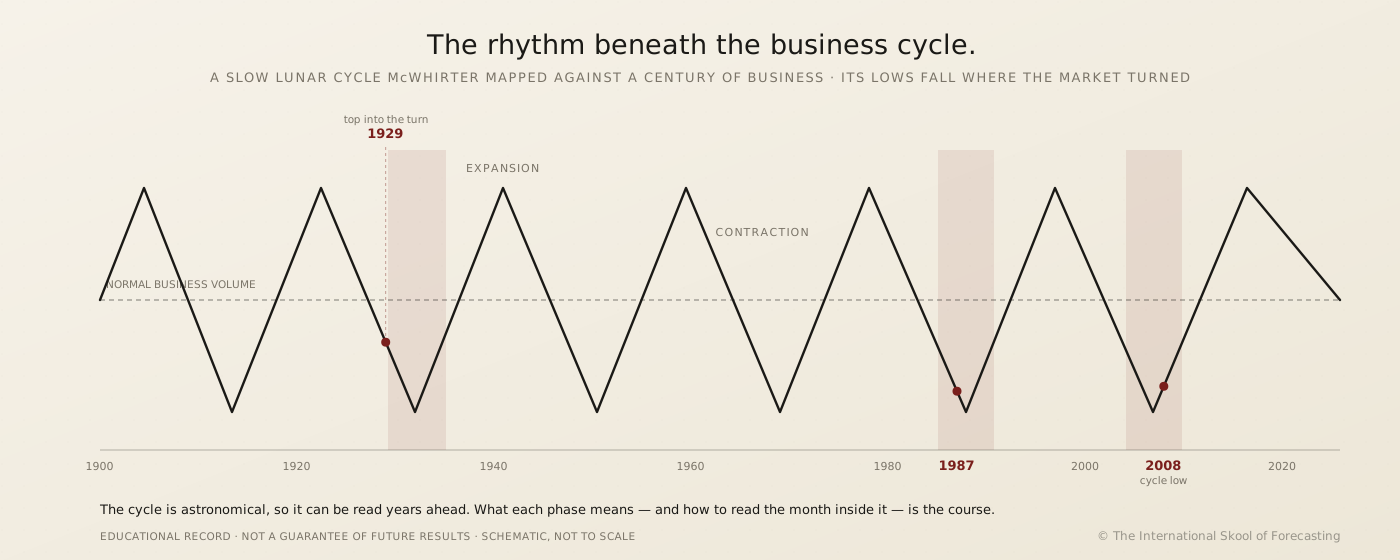
Louise McWhirter printed the method in one 1938 book, but scattered the theory, history, and application across it. This course rebuilds the work in the order it has to be used: the long business tide, the monthly directional reading, the founding-date chart for an individual stock, and the supporting factors that keep one clock from doing all the talking. Seven modules, 106 lessons. Stated plainly, it is financial astrology — lunar cycles and planetary positions read against a horoscope built for the exchange itself.
Not ready to buy? Read the full case →
One payment · Lifetime access · The Gann Time Table course included
First the long tide — where the economy sits inside an 18.6-year cycle that runs on an astronomical clock, which is why its next phase can be dated years ahead instead of guessed at afterwards. Then the month — a directional bias for the next 29.53 days, read against a horoscope built for the exchange itself, and written down before the first trade prints. Then the single stock — timing windows mapped from the company's own incorporation date, so you know which name is in season inside that month. Then the annual frame — David Williams' yearly method laid over hers, so two independent clocks either agree or warn you.
That is the whole method, and the order is not a teaching convenience. A monthly reading near a long-cycle low means close to the opposite of the same reading in a rising phase, so layer two is unreadable until layer one is finished. Reverse any two and the answer changes. Which is exactly what the 1938 book does to you — it prints all four, in the wrong order. Every case below is one of these four layers being tested.
We do not run student quotes here. The proof is older and harder than that: McWhirter printed her method in 1938 alongside the cases she built it from, and each one is dated, specific, and checkable against the historical record. Some of those cases look backward. One looks forward. Here is which is which.
In October 1929 Louise McWhirter was thirty-two years old, unpublished, and living in Bayonne, New Jersey. She did not call the crash. She could not have: the first American market-astrology magazine did not exist until 1933. What she did was trace the long cycle back through late 1928 in McWhirter Theory of Stock Market Forecasting — published in 1938, nine years after the fact — and show that it had entered its warning phase roughly nine months before the September 1929 peak.
That is a reconstruction, not a warning. Anyone selling you her 1929 "prediction" is selling you a hindsight chapter with the date filed off.
One more admission before the strongest thing in the book, and this one costs me sales. The out-of-sample record since 1938 is mixed — not quietly mixed, properly mixed. A cycle position that historically marked a high has, in a later era, coincided with recession instead. A position that marked a low has coincided with expansion. Those are inversions of her original reading, sitting in the actual record, and I know of no way to argue them away.
You would find this in month seven anyway. I would rather you found it here, before you spent AUD $1,994, than after.
Now what sits on the other side of that caveat — and it is better than the caveat is bad. In the same 1938 volume she carried the long business cycle out to 1950: twelve years of phase positions printed in advance, for years she had no way to see and no way to quietly revise afterwards.
That projection is the honest test of the method, and it is the one this course puts in front of you first. A researcher who publishes a dated projection has staked something. A researcher who explains 1929 in 1938 has not.
Her own worked Example 1 was U.S. Steel, timed against its incorporation date rather than its chart: 27½ in March 1935 to 126½ in March 1937. That is roughly 360%, from primary NYSE records.
Then read the rest of the arc, because the course teaches that too — U.S. Steel itself fell about 70% from that March 1937 high into the 1938 low. The same timing that produced the run ran in reverse. She wrote it up after the move, not before it, and a method that only shows you the first half of that sentence is not one you should pay for.
You do not take any of this on faith. In the course you rebuild the 1929 reading, her 1950 projection, and the U.S. Steel window yourself — from the cycle position up, in her sequence.
Then you start your own: a stated bias written down before each month opens, and the outcome logged whether it landed or not. Twelve months in, the proof you hold is not a sentence printed on a sales page. It is a stack of your own dated forecasts, misses included.
Enrolment is capped at 150 students worldwide. Not a timer — a ceiling. When the seats are gone, enrolment closes until a place opens, and no discount reopens it early. The reason is plain enough to state in one line: a forecasting method is an instrument while a few people read it properly, and a slogan once everybody repeats it. A slogan is worth nothing to the students who paid to learn the careful version. So the room stays small, and every student is verified by hand.
The material is not distributed anonymously. Every student in this program has been verified. You will be too.
You have almost certainly had the thought by now: a scan of the 1938 book is on the internet for nothing, and you want my passport for it? Fair. Here is the straight answer.
The 1938 text is one layer of seven. What you are paying for sits on top of it — the reconstruction work, the teaching sequence, the worksheets, the NYSE toolkit, the Secondary Factors app, and David Williams' annual method joined to hers. None of that is in the free PDF. The verification step protects that work, and nothing else: it does not gate your consumer rights, and it does not gate the book itself.
There is a second reason, and it is the one that matters more. A forecasting method that circulates free stops being an instrument. It becomes a meme. The terms get repeated by people who never learned to apply them, and the careful work of reading a cycle turns into a slogan. That devalues the study for every student who paid to learn it properly.
So you are buying a skill, not a subscription. Once you can locate the cycle, read a month, and time a stock against its founding date, no one needs to read it for you again. No renewal. Nothing to re-purchase. Before access opens you submit one photo — your face beside your government-issued photo ID, through a secure portal — and a member of the team reviews each submission by hand. The NDA you sign covers redistribution, public teaching, and resale. That is the whole gate.
The refund clause: No change-of-mind refunds once access is released. This does not limit your rights under the Australian Consumer Law. The verification step protects the community, not your right to a refund — if a submission cannot be approved, the team works with you directly to resolve it before access is released. Read the terms before you enrol, because once you are in, the research is in your hands and we treat that transfer as final.
A sales page that only tells you what is strong about a method is an advertisement, not an honest account. These are the questions a skeptical, careful buyer should ask — and the answers are the same ones taught inside the lessons.
Because that is exactly what it is, stated plainly rather than dressed up as something else. This course teaches a financial-astrology method — lunar cycles and planetary positions read against a chart built for the market. If that premise is not one you can work with, no amount of copywriting should talk you into it, and this is not the course for you. If you can hold the premise loosely enough to test it against the historical record yourself, the method is worth studying on its own terms.
The book is old; the method is not tied to any particular decade. It is a way of reading cycle position and lunation against a chart, and the inputs — the calendar, the exchange, the planetary positions — exist today the same as they did then. The out-of-sample record since is genuinely mixed: some periods line up with what the method predicts, some do not, and the course says so rather than claiming the model "still holds" in every market. You are learning a method to test yourself, not buying a guarantee it works today.
Honestly — mixed. Later cycle positions have both confirmed and contradicted the original reading. A position that historically marked a high point has coincided with recessions in one era, and a position that marked a low point has coincided with expansion in another. That is a real limitation of the method as originally stated, not a hidden one, and it is exactly why the course teaches you to reconstruct and test the record yourself rather than hand you a rule to trust blindly.
The 1938 book is one layer. The course adds the reconstruction work, the worksheets, the software toolkit, and David Williams' method on top of it — original material this school is not willing to see redistributed freely. The verification step protects that work, not your money; it does not gate your consumer rights in any way.
Because the moment you have the method, the research has been transferred, and there is no way to take that back. No change-of-mind refunds once access is released — that does not limit your rights under the Australian Consumer Law, and if something is actually wrong with what you received, that is a different conversation entirely.
A signal service sells you an answer every week for as long as you keep paying. This sells you the method once, and you do the forecasting yourself, for the rest of your career, with nothing further to buy. That is a slower start and a better outcome if you actually do the work — and a worse deal than a signal service if you were hoping to skip the work.
A copy of the rectified NYSE chart data provided in the course, a calendar, and the willingness to rebuild the 1929 reading and the U.S. Steel case yourself rather than take them on faith. No paid data feed or ongoing subscription is required to keep using the method once you have learned it.
You want signals, not a method
This course does not send you alerts. It teaches you to build the reading yourself, month by month. If what you want is someone to tell you what to do this week, this is the wrong purchase.
You will not do the reconstruction work
You rebuild the 1929 reading and the U.S. Steel window yourself, from the cycle position up. If you plan to watch the videos and stop there, you will finish with an impression, not a working practice.
You are not comfortable with ID verification and an NDA
Access is gated behind a photo ID check and a signed non-disclosure agreement, reviewed by hand before the course opens. If that process is a dealbreaker for you, decide that before you pay, not after.
You expect a refund if you change your mind
No change-of-mind refunds once access is released. This does not limit your rights under the Australian Consumer Law. If you are not fully decided, read the full letter first and take the time you need before you enrol.
The method reads from the large cycle down to the single stock, so the course is built that way too. A short orientation module opens it; six working parts follow, each producing the input the next part needs. Take them out of sequence and you get noise — which is precisely what happens to everyone who reads the 1938 book straight through. You leave holding a working practice, not a folder of watched videos.
Plainly stated: this is a financial-astrology method. Every part above is built from lunar cycles and planetary positions read against a chart, not chart patterns or fundamentals — the same primary-source system McWhirter published in 1938. If that is not what you are looking for, this is not the course for you.
You are enrolling in Version 1 of the course — the complete, working method as McWhirter and Williams laid it out, ready to apply today. Version 2, an expanded edition, is already in development; when it ships, it's yours free as part of lifetime access.
First, who you become. On one side of this line you wait for the chart to confirm a turn, then call yourself early. On the other you write a bias down in your own hand before the month opens, place it inside the long tide, and let the date arrive to confirm or correct you. Same market. Completely different person reading it.
Second, what waiting costs. This skill is not bought once and finished — it compounds, one worked month at a time, and the judgement lives in the stack of cases, not in the videos. Enrol this month and a year from now you hold twelve dated forecasts with the hits and misses both logged. Wait a season and you hold nine. Wait until it feels convenient and you hold none, and the clock McWhirter read will have moved anyway.
Third, exactly what you get. Seven modules, 106 lessons, in her sequence. A five-year macro outlook you build yourself. Monthly forecasting worksheets and the NYSE toolkit. Incorporation-chart workbooks. The Williams annual layer. The Secondary Factors app. The Gann Financial Time Table course free. Version 2 is in development and lands in your account at no extra cost when it ships. One payment, and it is yours for the rest of your career.
Enrolment process — After payment, complete a two-minute identity check via Stripe (government ID + selfie) and sign a non-disclosure agreement. Course access is issued after both are reviewed.
Enrol — AUD $1,994 →No change-of-mind refunds once access is released · This does not limit your rights under the Australian Consumer Law
P.S. — If you skipped to the bottom, here is the whole case in one paragraph. Louise McWhirter did not predict the 1929 crash; she explained it nine years later, and any page telling you otherwise is lying to you. What she did do in that same 1938 book was project the long business cycle forward to 1950, and work one stock — U.S. Steel — against its incorporation date from 27½ in March 1935 to 126½ in March 1937, roughly 360%, before it gave about 70% of that back into the 1938 low. Her method is real, it is financial astrology, and the record since contains real inversions of her original reading — positions that marked a high in her data coinciding with recession in a later era. This course is the 106 lessons that rebuild it in the order the book scrambles, for AUD $1,994 once, in a room capped at 150 students worldwide. If that premise is not one you can work with, close the tab with our blessing. If it is, enrol here and write your first month down before it opens.