
Time by Solar Degrees · W.D. Gann's solar timing method

Mark repeatable market-turn windows months ahead. Gann's solar-degree method starts with the Sun's actual motion — not a flat calendar count.

The Sun does not move at a constant speed. The four quarters of the solar year are different lengths, so a flat calendar count can slide out of line with the market. The course shows you how to work with the actual solar degree position instead.

Twenty-five lessons across five modules teach you to mark a turn window by hand, months ahead, on a market you watch. You get the chart-only shortcut, the full solar-degree method, and the 2024 Dow study walked date by date with the dead dates counted out loud. A window is a place to investigate — not a guaranteed buy or sell signal.

One payment · Lifetime access · Identity check and NDA required before access is released. Refund terms
2024 The Dow year walked date by date — five dead dates counted out loud
6.9% How much the sun's apparent speed varies across the year
By hand A free ephemeris, no service to rent
Lifetime A skill you keep, not a feed you pay for
§ The record · Why this timing layer deserves study

The proof for this course is one complete study, including the misses.

This page does not borrow proof from another product. The evidence here is the 2024 Dow Jones study inside the course: the dates are shown across the full year, and five dates that did nothing are counted. That is a worked study, not a promise that every window will produce a market turn.

The course walks a 2024 Dow Jones study across the full year. You watch the turn dates tracked month by month, and you learn to read a build of tops on those dates as a warning that a major top is forming. Five dates in that year did nothing at all — they are marked in a different colour and counted out loud, because you cannot learn to read the distribution from a reel of winners. A worked study, not a promise about the next move.

2024 · Dow Jones study
The method applied, over your shoulder
§ Why now · The window does not wait for you

The method gives you a dated window to investigate. You decide what to do with it.

There is no deadline on this page and I am not going to invent one. Nothing here expires at midnight. The pressure is arithmetic, not marketing.

It is this. A window is only worth something if you can read it before it opens — and the reading takes a few weeks to drill. Start once a window is already on top of you and you will learn that turn the way everyone else learns it. From the chart. In hindsight. After the easy part has gone.

That is the whole of the urgency, and it is enough. A turn that lands inside a window carries weight. A turn that misses it moves to the next one. Either way the calendar keeps running.

Which is the part worth sitting with. This course is worth most to you the day you finish it — not the day some market finally resolves. The work you do while nothing is happening is the only thing that gives you standing to act when something is.

What you learn to do Mark the turn window months ahead
Source tradition W.D. Gann
Solar year 365.2422 days
Working tool A free ephemeris
§ The offer · What you learn · What you pay

Twenty-five lessons. Five modules. One method you can reuse on future markets.

By now you are probably weighing one of two thoughts. That this is astrology with a spreadsheet — which is fair, and my answer is that it is a solar-degree timing method and I am not going to call it something else to make you comfortable. Or that a hundred-year-old method cannot survive a market run by machines — which misreads the timescale, because algorithms compete over milliseconds to days and a window named months ahead is not in that race. Either way, what you get is not a video series. It is a reading you learn to do by hand, test against your own charts, and mark in advance.

  • Time by Degrees. Why price is late, and why a flat day count drifts out of line as the sun changes speed. What a solar-degree window is, and what it is not.
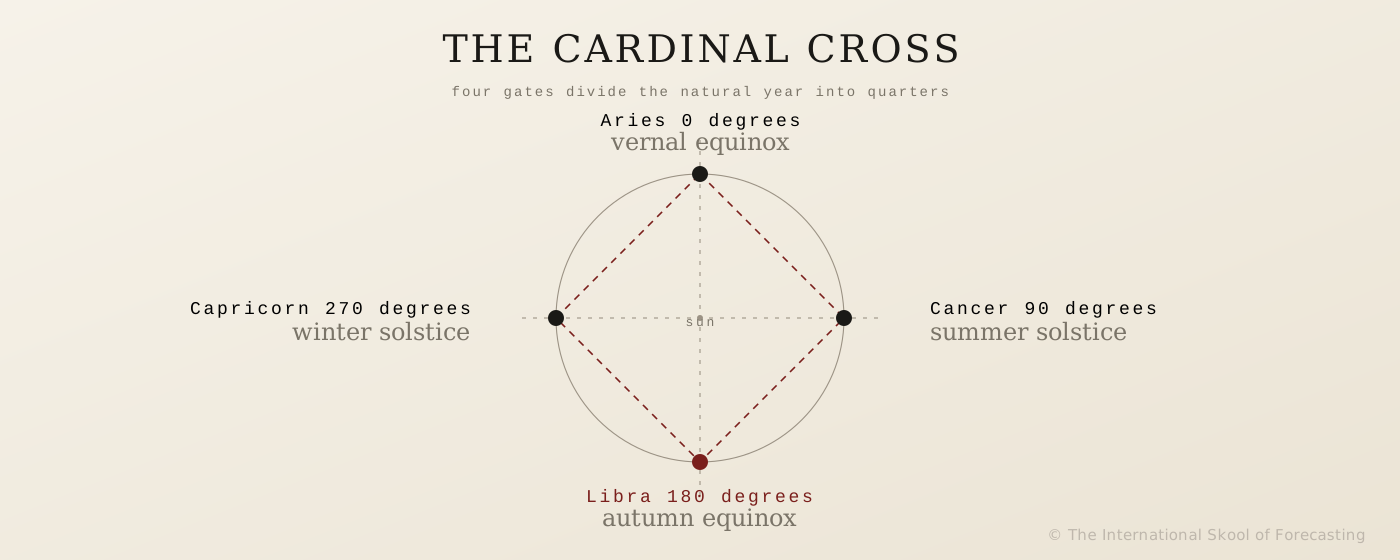
  • Counting with Time. The four cardinal points of the solar year — the equinoxes and solstices — and how major swings cluster around these seasonal hinges. How to carry a prior high or low forward to the months to watch.
  • The Lazy Man's Method. The chart-only way to mark repeating turn dates without an ephemeris. Once you see the same dates recur across markets, you cannot unsee them.
  • Tools & Confluence. The heaviest module, seven lessons. The spreadsheet that does the arithmetic. The 2024 Dow Jones worked over your shoulder across a full year. A cold-start reading of India's Nifty 50 — an index I do not follow and have never traded. And the lunar layer that narrows months to weeks.
  • Advanced Applications. Intraday and long-range work, then the mistakes read back off real student charts — the ones people actually make, not the ones a course invents. Ends with the annual map.

Also included in The Market Forecaster (AUD $6,997), which bundles every current and future course.

Astro-timing services of this kind are sold by subscription — often four figures a year, renewed for as long as you watch the market Rented yearly
The full solar-degree method, worked end to end — the reading skill is yours, with no feed to renew Yours for life
The 2024 Dow Jones case study, walked date by date — calls and misses both on the table Included
The working tool is a free ephemeris — there is nothing to buy beyond the course, and nothing to keep paying for Free tool
The trade is plain: rent a forecast feed by the year, forever — or own the reading once, for life One payment, for life
You pay — once, lifetime access AUD $2,997
Enrolment
AUD $2,997
One payment · Lifetime access

  • Twenty-five lessons across five modules
  • Time by Degrees · Counting with Time
  • The Lazy Man's Method
  • Eclipses and moon phases for confluence
  • A 2024 Dow Jones case study
  • A cold-start reading of the Nifty 50
  • Lifetime access after verification
Enrol — AUD $2,997
Identity check and NDA before access. Refund terms
§ The objections · Asked and answered before you spend a dollar

Seven fair criticisms of this method. Including the two that are aimed at me rather than at Gann.

A page that only tells you what is strong about a method is an advertisement. These are the questions serious people actually ask.

"Did Gann actually teach this, or is it attributed to him?"

Be careful with anyone who answers that too confidently, including me. The words "solar," "ephemeris" and "zodiac" appear nowhere in The Tunnel Thru the Air or Truth of the Stock Tape — you can search both yourself, they are freely available. What Gann did put in print, in 1923, is this: "watch for change in trend every 3rd, 6th, 9th and 12th month… if a stock makes bottom in the month of August… the most important date would be the following August or one year later." That is the anniversary principle, in his own words, anchored to the prior turn rather than the calendar. The solar-degree working method is what practitioners built from that. I would rather tell you where the line falls than let you find it later.

"Isn't a yearly anniversary just a flat calendar count?"

That is exactly the problem the method exists to fix, and here is the size of it. The sun's apparent speed varies by 6.9 percent across the year — 0.9534° a day in early July, 1.0193° a day in early January. So the four true quarters of the solar year run 92.76, 93.65, 89.84 and 88.99 days. A flat ninety-day count is 3.65 days wrong by the September quarter. Every one of those numbers is computable from first principles and none of it requires you to believe anything about markets.

A circle divided into four gates at ninety-degree intervals, marking the vernal equinox, summer solstice, autumn equinox and winter solstice as the four corners of the solar year.
Four gates, four true quarters — not four equal calendar slices

"Doesn't the whole thing drift out of alignment over the years?"

No, and this is the part most people have backwards. The sun returns to the same zodiacal degree on the same calendar date, and it stays there: across a full four-year leap cycle the slippage is about forty-five minutes, and over a century it is under a day. The anchor is stable. What drifts is the flat day-count people use instead of it. If you have read the opposite somewhere, check it against an ephemeris before you believe it — it takes about a minute and it is the kind of claim you should never take on trust, including from me.

"Isn't this just curve-fitting to charts you already know?"

The fair test of that is a cold start, so the course contains one, and it is a named lesson you can hold me to: the timing rules applied to India's Nifty 50. I state on camera that I do not follow that index and have never traded it, derive its turn dates from scratch in about five minutes with no preparation, and let the cluster fall out where it falls. You watch it happen in one take. If the method only worked on instruments I had studied for a decade, that lesson would be impossible to film.

"You'll show me the hits and quietly skip the misses."

In the 2024 Dow study I mark the failures in a different colour and count them out loud — five dates that did nothing, by my own tally, in a single year's worth of windows. The point of that study is not that every date fires. It is that the distribution of what lands is readable, and you cannot learn to read it from a reel of winners.

"Weather? Really?"

It is the strangest thing in the course and I would raise an eyebrow too. To be exact about what is and is not claimed: there is no suggestion that the weather anywhere moves any market. The claim is narrower — that both respond to the same upstream driver, and that lining the two up tightens the window rather than pointing a direction. In the lesson itself you watch a five-day window narrow to roughly forty-eight hours on a worked case, and I say on camera exactly how far I would trust that and no further. So do not take the number from this page. Take it from the lesson, and then go and try to break it on your own market. Test it and discard it if it does not hold for you. It is one lesson out of twenty-five. Skip it and nothing else in the method breaks.

"Will this tell me what to buy?"

No, and it is not built to. There are no signals, no alerts and no positions — it produces windows in time, and what you do inside one is entirely your decision and your risk. Nothing here is financial advice and nothing accounts for your circumstances. If you want to be told what to trade, this is the wrong purchase and I would rather say so now.

§ Do not enrol if

Four kinds of trader should keep their money. I would rather lose the sale than the correspondence.

You want signals

There are none, and there never will be. This teaches you to produce windows yourself. If you want somebody to tell you what to do on Tuesday, buy that instead — it exists, and it is not this.

You need certainty before you act

These are probability windows. Strong one-directional markets can run straight through one for days before they take any notice. If a method has to be right every time before you will use it, no timing method will ever suit you.

You want it automated

There is a spreadsheet that does the arithmetic, but the judgement is yours and it takes a learning curve. Nobody has ever finished this course in a weekend and been good at it.

You haven't read the free essay yet

The solar ingress essay in the library is free and it is the honest first step. Read it, try the idea, and only come back if it earns your interest. It costs you nothing and it will tell you more than this page can.

§ Why this is gated

A skill you own. Not a service you rent.

The source sits in W.D. Gann's work, written in old prose and parable that most readers cannot parse alone. What is not in print is the working form — how to read a window, how to tell a strong date from a weak one, and how the moon and eclipses sharpen it. Jonathan has spent more than a decade reading, testing, and teaching this to a small number of students.

If that working form were handed out openly, the edge would thin for everyone who did the study. The NDA keeps the method worth learning. It is not a marketing trick. It is the condition that keeps the room serious.

Once you can read the window, the skill is yours. No monthly fee. No renewal. You re-run the work on any future cycle, for any market, with nothing more than a chart and a free ephemeris. No service owns it. You do.

Enrolment requires identity verification and a signed NDA. Access is released once verification is complete.

The refund clause: No change-of-mind refunds once access is released. This does not limit your rights under the Australian Consumer Law. The verification step protects the community, not your right to a refund — if verification cannot be approved, no access is released and we work with you directly to resolve it. Read the terms before you enrol, because once you are in, the research is in your hands and we treat that transfer as final.

§ The decision · Build the timing method before the next solar turn

After the course, you can calculate and test the next solar-degree window yourself.

That is not a mood. It is a change in what you are looking at. Right now the chart is a record — it tells you what already happened, and you decide after the fact whether to believe it. After this course the same chart carries a second layer: windows you marked months ago, in your own hand, before the market had given you any reason to. You stop asking what just turned. You start the year already knowing when the next turn is due.

Then there is the other side of it. The next window arrives whether you can read it or not — that has never once depended on you. The only thing in question is whether you name it in advance or recognise it afterward, in hindsight, from a chart. Walk away and you keep paying the same tax you have been paying: the entry a week early, the exit a week late, the move chased at twenty percent extended because by the time it was obvious it was already gone. That bill does not arrive once. It arrives every cycle, for as long as you watch markets.

And here is exactly what changes hands for one payment — twenty-five lessons across five modules:

  • The full solar-degree method, worked by hand on a free ephemeris
  • The four cardinal points of the year and how swings cluster on them
  • The Lazy Man's Method — read repeating turn dates from the chart alone
  • Eclipses and moon phases for confluence, to narrow the window
  • A 2024 Dow Jones case study, walked over your shoulder
  • A cold-start reading of the Nifty 50 — an index I have never traded
  • A skill you re-run on any future cycle — no subscription, no renewal
AUD $2,997
One payment · Lifetime access

Enrolment process — After payment, complete a two-minute identity check via Stripe (government ID + selfie) and sign a non-disclosure agreement. Course access is issued after both are reviewed.

Enrol — AUD $2,997

Identity check and NDA before access. Refund terms